

Table of Contents
Snapbar vs Activation King isn't a feature race. It's a question about what you're buying. Activation King sells photo booth software to the people who run booths, from $49 a month for a license that activates on two devices. Snapbar delivers the activation itself, from $1,995, with the platform, the guest volume, the displays, the lead capture and delivery in one price. Both roads end with a guest holding an AI portrait. Almost nothing in between is the same purchase.
That difference decides your procurement path: a monthly subscription plus a shopping list, or one scoped number in a budget line. This is a spoke off our guide to comparing photo booth software for corporate events.
Key takeaways
- Activation King sells an operator ecosystem: booth software from $49 a month, turnkey hardware, separate mosaic and drawing products.
- Snapbar delivers the activation from $1,995, on a kiosk, an iPad, a laptop, guests' phones, or all of them at once.
- Their license activates on two devices at a time. Snapbar doesn't charge for devices or concurrency.
- Their mosaic is a separate product from $269.00 a month. A gallery, slideshow and leaderboard come with every Snapbar activation.
- The two headline prices are different units, so we price the same 500-guest event both ways below.
Who is each one built for?
Activation King says it plainly on its own homepage: "Build and Grow Your Event Business With One Ecosystem," for "Event professionals, photo booth operators, agencies, venues and brands," with segment pages for booth owners, rental companies, DJs and photographers. It's built for someone whose business is running booths for other people's events.
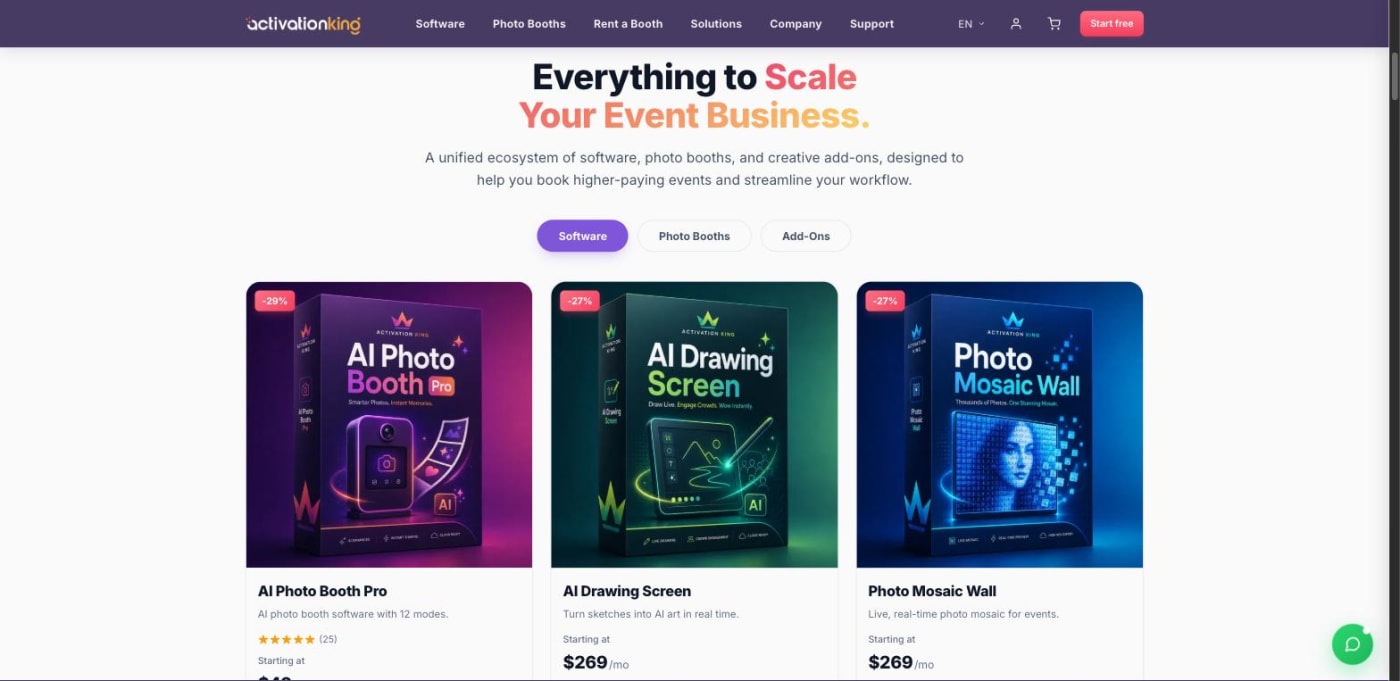
That's a real market and a well served one. An operator with a van and thirty bookings needs software they own the client relationship with, hardware they can depreciate, and a monthly cost that spreads across every job. Activation King has all three in one place.
Snapbar is built for the other side of that transaction: the corporate event marketer with a brand activation or a conference booth on the calendar, buying an outcome rather than an inventory item. One event, a brand team with opinions about it, a sales org that wants the leads. So the useful question isn't better or worse. It's whether you're renting the booth out, or the one it's being set up for.
Snapbar vs Activation King side by side
Every Activation King cell comes from their own published pages, checked September 2026. Where a page doesn't state something, we say so.
| Snapbar | Activation King (AI Photo Booth Pro) | |
|---|---|---|
| What it is | An experiential marketing platform; we deliver the activation, you run the event | Photo booth software for operators, sold alongside turnkey hardware and separate mosaic and drawing products |
| Pricing model | Priced per experience, per event, however many devices or screens you use | Monthly software license per subscription, plus AI credits bought separately |
| Published entry price | $1,995 for the Digital Photo Booth; $2,495 for the AI Photo Booth | Starter $49/mo, Pro AI $79/mo, Ultimate AI $149/mo, promotional at the time of checking, September 2026 |
| Annual pricing | 1-year runtime available as a $1,495 add-on | An annual saving is advertised; no annual dollar amount is printed on the pricing page |
| Devices running at once | Unlimited and simultaneous, at no charge for devices or concurrency | "2 devices, unlimited events," on any platform mix, per subscription |
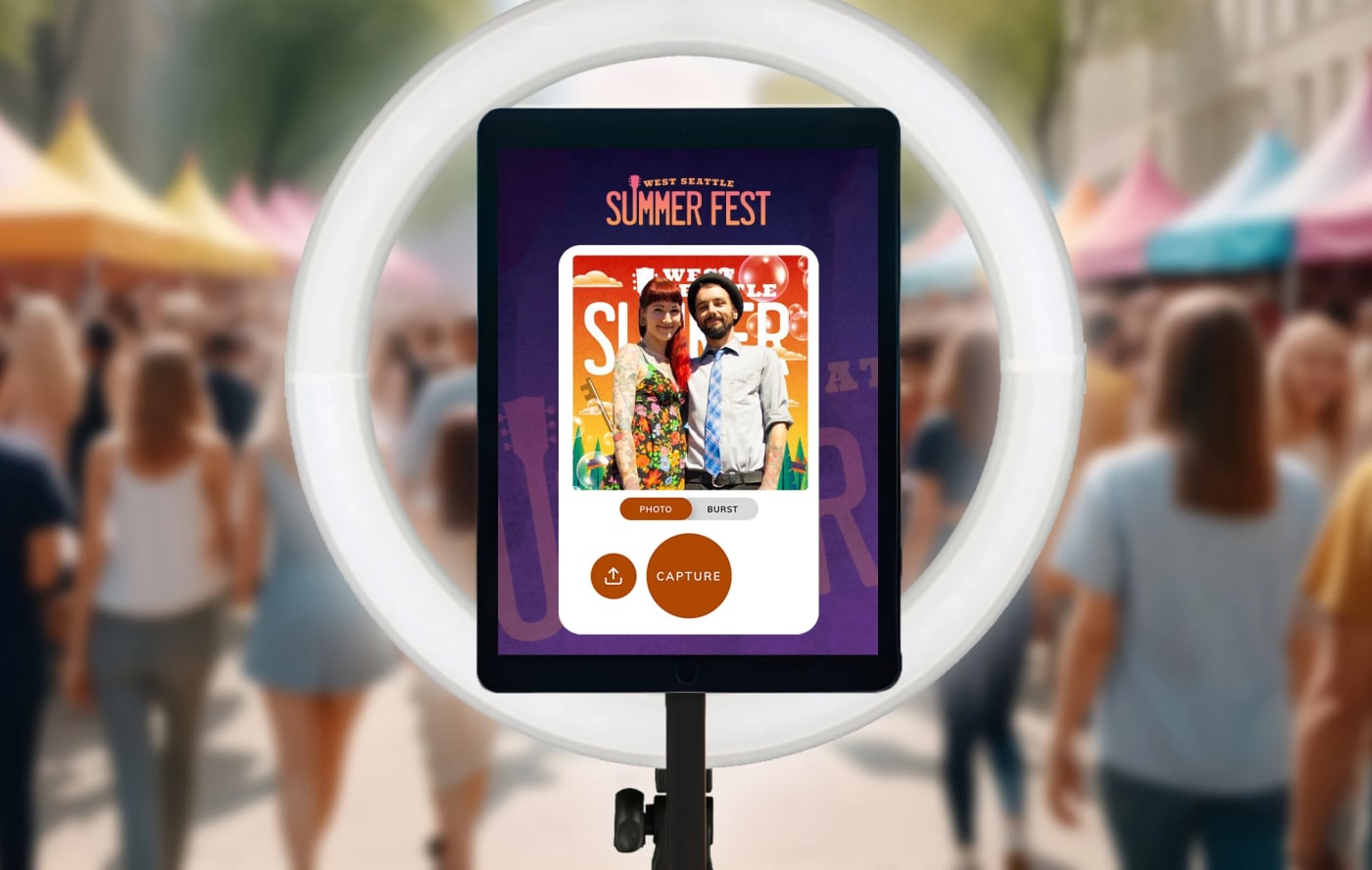
| Platforms | Browser-based, so any device with a browser: kiosk, iPad, laptop, guests' phones | Native apps for "Windows, macOS, iOS and Android" |
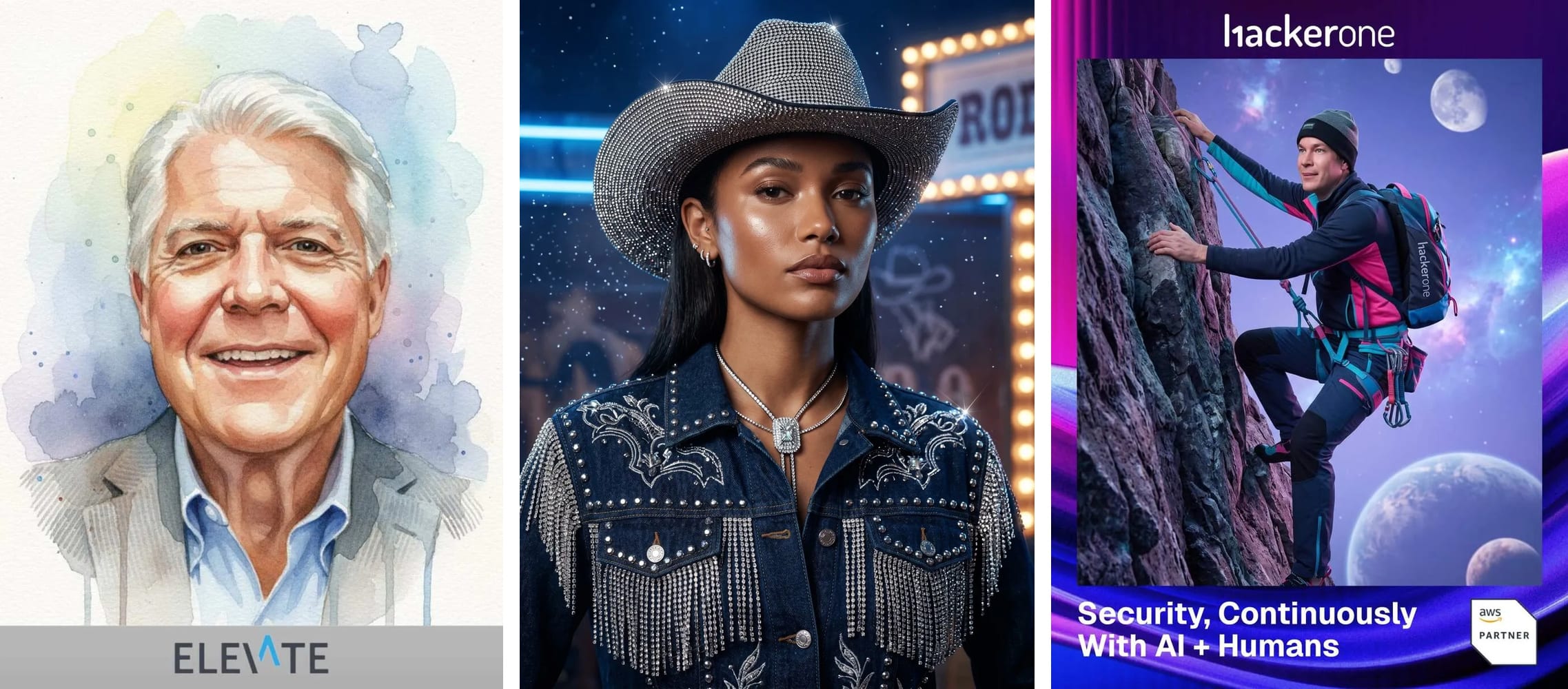
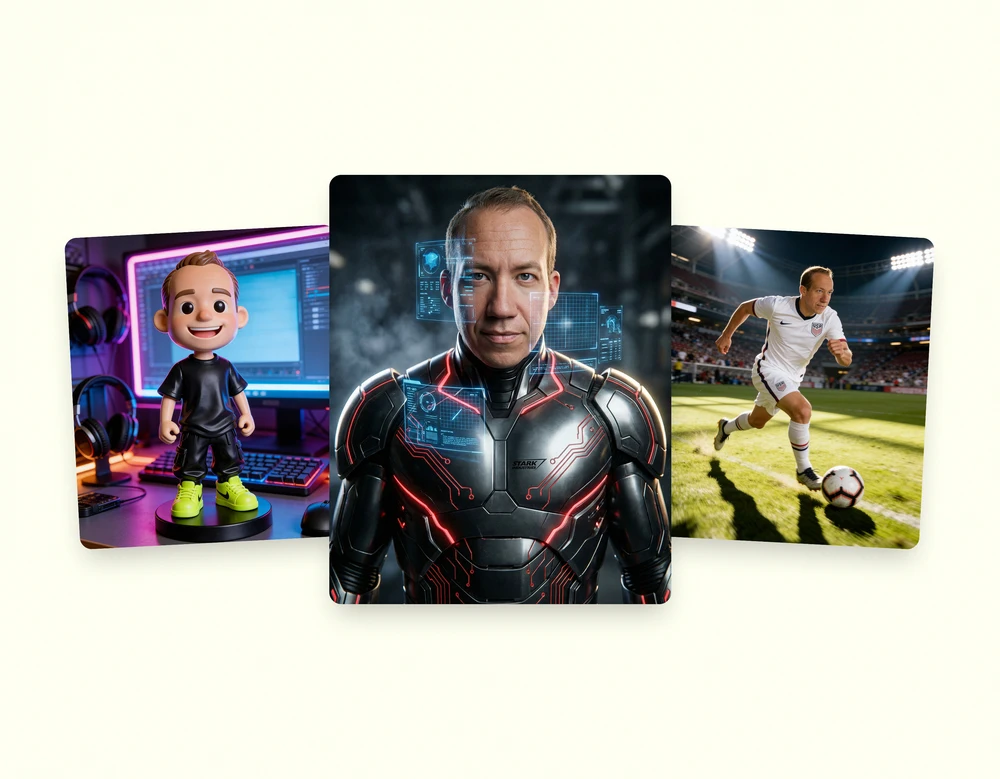
| AI output | AI portraits with custom prompts and styling, plus the option to blend a second photo into any AI portrait | "120+ AI styles & Create Your Own," face swap, AI video, AI background removal, from the Pro AI tier |
| Usage costs | Included guest volume with every experience; approximate totals published below | AI credits are separate from the subscription and priced per operation; pack price not published on the pages we checked |
| Displays in the room | Live gallery, slideshow and leaderboard included with every activation, unlimited instances; live mosaic is the one add-on | Photo Mosaic Wall is a separate product "From $269.00/mo"; live gallery, slideshow and leaderboard not stated publicly |
| Lead capture | Flexible data capture step inside the experience, consent-gated by default | "Collect names, emails, phones, and survey responses," with an on-screen disclaimer before the shot |
| Where lead data goes | Real-time delivery into HubSpot, Slack, signed webhooks and Zapier, plus a partner API, pilot-gated per account and configured with our team; bulk exports alongside | "Export all leads per event instantly"; CRM, webhook and API destinations not stated publicly |
| Branding | Subtle Snapbar branding on guest-facing surfaces by default; the Whitelabeling add-on at $1,495 removes it | "White labeling & priority support" listed in the top tier on the pricing page, at $149/mo |
| Hardware | Bring the hardware you have, or use none | Sold, not required. "AK Photo Booth Pro 32": Starting at $8,500.00" |
| Trial | No published free trial or self-serve signup. Experiences are scoped and quoted with our team | "14-day free trial, no credit card, no auto-charge," with watermarked output and 100 credits |
Theirs is a catalog of things you assemble. Ours is a scope of work with a price on it.
What does each one actually cost?
The two published numbers are not the same unit, so comparing $49 to $1,995 tells you nothing. One is a software license you renew monthly across every event you run, the other is a delivered activation for one event. What's worth comparing is the event, priced both ways.
Activation King publishes three AI Photo Booth Pro tiers: Starter at $49 a month, Pro AI at $79, Ultimate AI at $149. All three are shown struck through from $69, $99 and $199 with a countdown running, so treat them as promotional at the time of checking, September 2026.
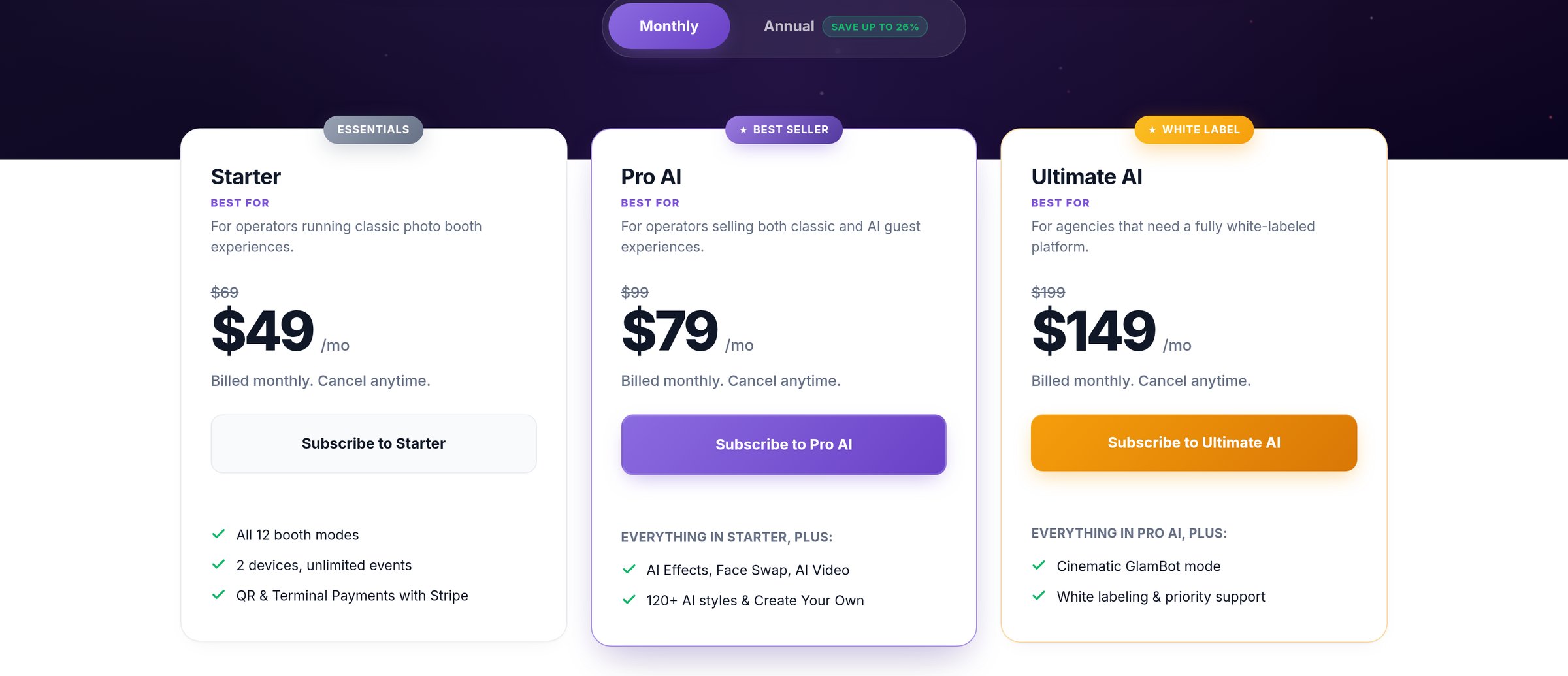
Now price a real job: AI portraits with face swap, 500 guests, one two-day conference. On their model the software is one line, Pro AI at $79 for the month it runs. AI credits are bought separately from the subscription, and the credit pack price is not published on the pages we checked. You supply the capture device: their turnkey AK Photo Booth Pro 32" starts at $8,500.00, and any device you bring instead is your own cost, not published. You supply the person who builds it, runs the floor and packs it down, and no staffing figure is published either. If the client wants a mosaic wall, that's a separate subscription from $269.00 a month.
Our floor is published too. Snapbar photo-based experiences start at $1,995, which includes full platform access and the core features needed to run a successful event, from custom lead capture to unlimited displays. That Digital Photo Booth covers 500 guests. The AI Photo Booth starts at $2,495, and the 500-guest AI activation above runs approximately $3,200.
So here's what each figure leaves out, and what it covers. Their $79 buys the software license for that month and none of the other lines above: the credits, the capture device, the crew and the mosaic wall are separate purchases on their own published pages. Our approximate $3,200 covers full platform access, the guest volume, 30 days of live runtime, unlimited admins, custom experience branding, the three displays, flexible lead capture, branded email delivery, real-time shareable analytics and live moderation.
Neither list is a criticism, and the arithmetic favors them in one direction: an operator running thirty events a year spreads that $79 across all thirty, and per event their model wins outright. For one brand running one activation, the same shopping list is a project rather than a line item. Snapbar vs Pictor prices the same trade against a monthly licence with AI sold as tokens.
How many devices can run at once?
Two, on their side, per subscription. Their pricing page states it directly: "2 devices, unlimited events," and "One subscription activates on 2 devices simultaneously, on any platform mix." That mix is a real strength: a Windows laptop and an iPad share one license. A third capture point is a second subscription.
Snapbar doesn't count devices. The experience runs in a browser, so you deploy it however the event wants: a kiosk at the booth entrance, an iPad on a stand by the coffee, a laptop at registration, every guest's own phone by QR code, or all of the above at once. Simultaneous use is unlimited, with no charge for devices or concurrency.
Why that matters is queue math. One capture point at a 500-person reception is one line, and everyone who will not stand in it is a guest you did not capture. Two kiosks, a roaming iPad and a QR code on every table is four capture points instead of one, at the same price. We go deeper on per-device licensing in Snapbar vs Snappic, and on booth-count tiers in Snapbar vs AI PhotoBooth.
What does the crowd see?
Activation King sells a display, and it's a good one: the Photo Mosaic Wall, "From $269.00/mo," where "Guests' photos build a giant mosaic, live in the room." It's a separate product on its own subscription. A live gallery, a slideshow and a leaderboard are not stated publicly on the pages we checked.
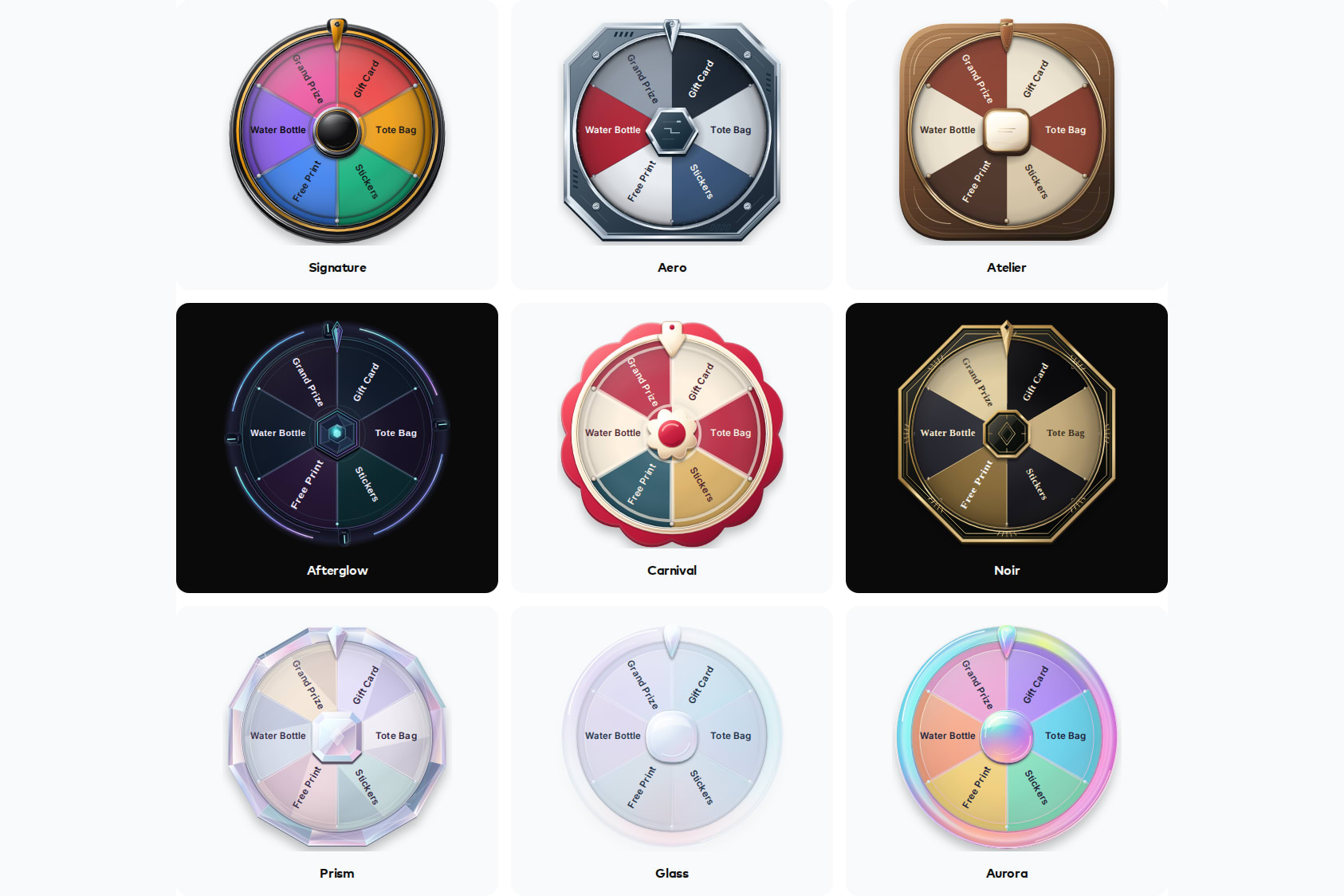
Every Snapbar activation includes three displays: a live content gallery, a dynamic slideshow and an interactive leaderboard with guest upvoting, plus a scannable code so passers-by can vote from their phone. Run as many instances as you want at no extra cost, which is the part buyers re-read: twelve screens across the booth, the lounge and the main stage cost the same as one. Sponsor QR codes sit on the gallery and slideshow. The live mosaic is the one add-on.

The reason to care isn't screen count. Content guests make is only marketing fuel while other people can see it, and a gallery on a 55-inch screen at the aisle is what pulls the next twenty guests into the line. Live event displays compared covers when each type earns its place.
Where does the lead data go?
Both platforms capture leads. What differs is the next ten seconds.
Activation King's product page describes forms that "Collect names, emails, phones, and survey responses. Export all leads per event instantly," with an on-screen consent step: "Show a disclaimer before every shot; guests agree on screen before the camera fires." Consent before capture is good practice, and worth crediting. CRM, webhook and API destinations are not stated publicly on the pages we checked.
On our platform the data capture step is consent-gated by default: non-consented personal details are dropped before anything fans out to a connected system, while the guest's content still processes and still arrives. Lead data is delivered in real time into HubSpot, Slack, customer-supplied signed webhooks and Zapier, plus a published partner API, and that delivery is pilot-gated per account and configured with our team rather than something you switch on yourself. Bulk exports sit alongside it, with structured file naming so the zip and the spreadsheet line up on import.
The difference is the follow-up window. An export is a file someone downloads once the show is over, which after a Thursday close usually means Monday. Live delivery puts the record in front of a rep while the guest is still on the floor. More in where your event lead data actually goes.
Whose brand is on it, and who builds it?
Both companies put their name on the output by default and both sell the removal, at different price shapes. Activation King bundles "White labeling & priority support" into its top tier on the pricing page, at $149 a month, so if you already want the full AI stack, white labeling arrives with it. Snapbar shows subtle Snapbar branding on guest-facing surfaces by default: the microsite footer, displays, delivery emails and sharing page. The Whitelabeling add-on at $1,495 removes it. Theirs is the better arrangement across a full calendar; for one activation, ours is a single line on one quote.
Then the question nobody puts on a pricing page: who actually builds the thing. On their model, you do, and an experienced operator will build a better booth than most agencies. On ours, the platform gives you immediate control over branding and design elements, while the Snapbar team provides expertise and guidance on the more complex parts, the AI prompts and the data flow. If nobody on your team has written an image prompt that has to flatter 500 strangers under ballroom lighting, that second half is the value.
See it in action
AI portraits your brand team will actually approve
Custom prompts and styling built with our team, running on a kiosk, an iPad, a laptop or every guest's phone at once, displays included.
Explore the AI Photo BoothChoose Activation King if, choose Snapbar if
Activation King is the better fit if you're building or running a photo booth business: a license you renew monthly and spread across a full calendar, face swap and AI video on Windows as well as iPad, hardware you can own, and you're happy to supply the credits, the device and the crew, because that's already the business.
Snapbar is the better fit if one brand is running the activation: a number you can put in a budget line, a kiosk, an iPad, a laptop and every guest's phone all running at once with no charge for devices or concurrency, displays working the room while the line moves, lead data reaching your CRM during the show, and a partner who builds the AI prompts with your brand team.
The same comparison runs against Snappic, Simple Booth, Movebooth and Dreamwave, with the wider field in the best AI photo booth software. The newest head-to-heads are Snapbar vs Pictor, Snapbar vs PONS and Snapbar vs AI PhotoBooth. Not sure which side you're on? Ask us.
Want an AI Photo Booth priced for your guest count?
Tell us the event, the headcount and the room, and we'll come back with a scoped number.
Get a QuoteOr explore: AI Photo Booth | Lead Capture
Sources: Activation King facts were checked in September 2026 against activationking.com, on the homepage, the AI Photo Booth Pro product and pricing pages and the photo mosaic wall page; where a page did not state something, we say so rather than infer it. Snapbar figures come from the Snapbar platform pricing page, checked September 2026, with guest-count totals approximate.