
Table of Contents
Giveaways work. People slow down for them. The harder question is who walks away with them. By eleven on day one, the bowl on your counter is half empty, and a lot of it is riding home in the bags of people who were never going to buy.
A trade show prize wheel fixes the who, not the how many, as long as you run it as a play and not a party trick. Here's the play: a digital prize wheel that sits behind your data capture step, with odds and inventory you control, and a claim your team can count when the show closes.
Key takeaways
- Guests give their details, spin a branded wheel and come back to claim what they won. You decide which prizes go on the wheel and how rare the good ones are.
- A free bowl attracts people who like free things. Asking for something first changes who takes your swag.
- Odds and inventory are separate decisions. You control the odds for each prize, so a headline prize can stay rare while you still have plenty of it.
- The dashboard counts players, winners and claims. Whether each player was the right visitor is your team's call.
What is a trade show prize wheel?
A trade show prize wheel is a spin-to-win game that hands out your booth giveaways by chance. A guest spins, the wheel settles, and if it lands on a prize, they claim it. The cardboard version stands on a tripod next to a box of stickers. A digital prize wheel runs on a screen and keeps the books for you.
Our CEO, Sam Eitzen, described the cardboard version from the visitor's side on Sorgatron Media's Awesome Chat: "I spin the wheel, I didn't get it. And I'm like, thanks guys. And I walk away. No badge scan, no interaction."
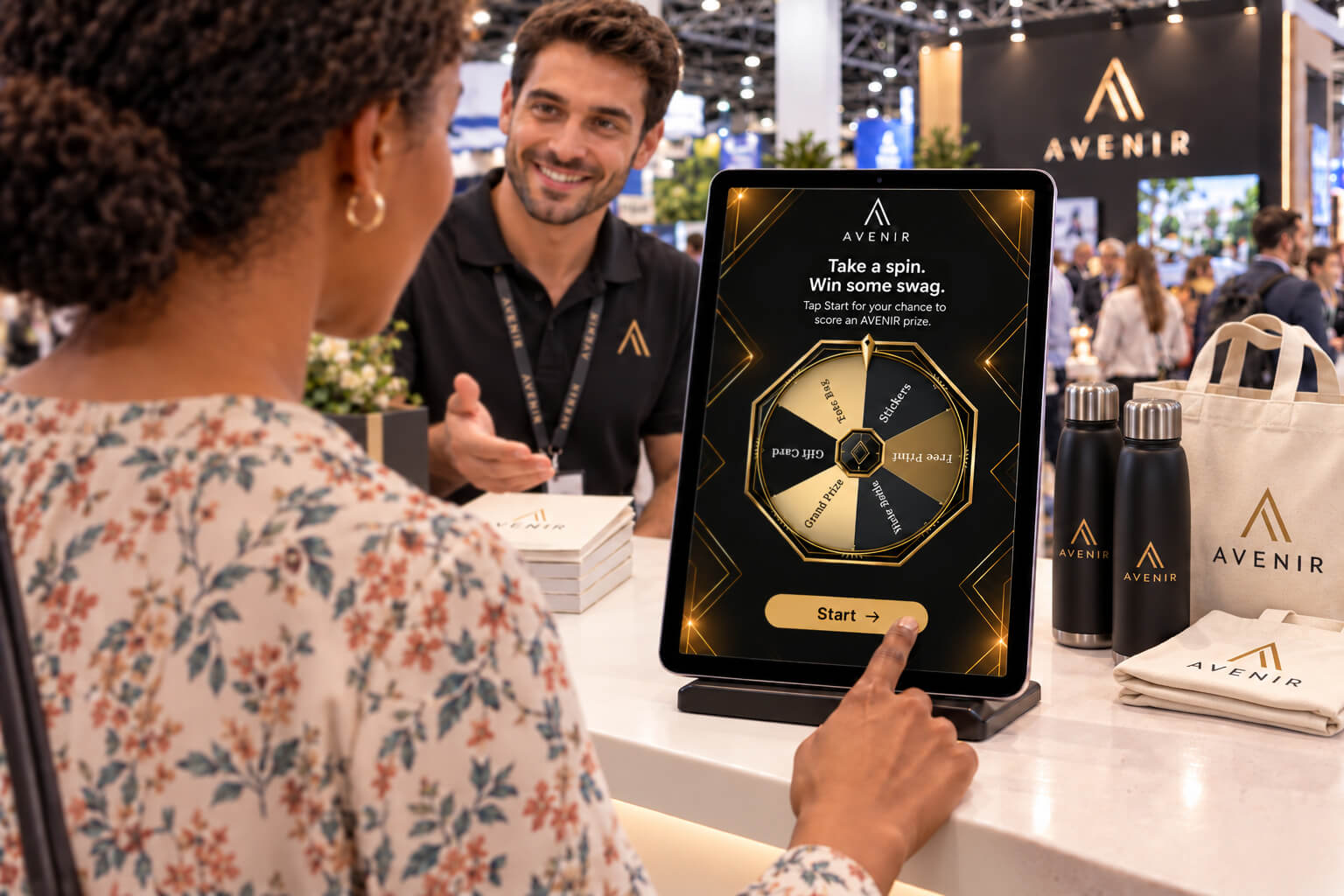
Spin to Win is ours. On a tablet, a link or a QR code, guests land on a gently moving branded wheel, tap Enter, add their details and spin. That entry step captures their details and consent as a lead, once, before the spin. You can also put the wheel on a big screen and let guests spin from their own phones, with entry on the phone while the wheel plays on the wall.
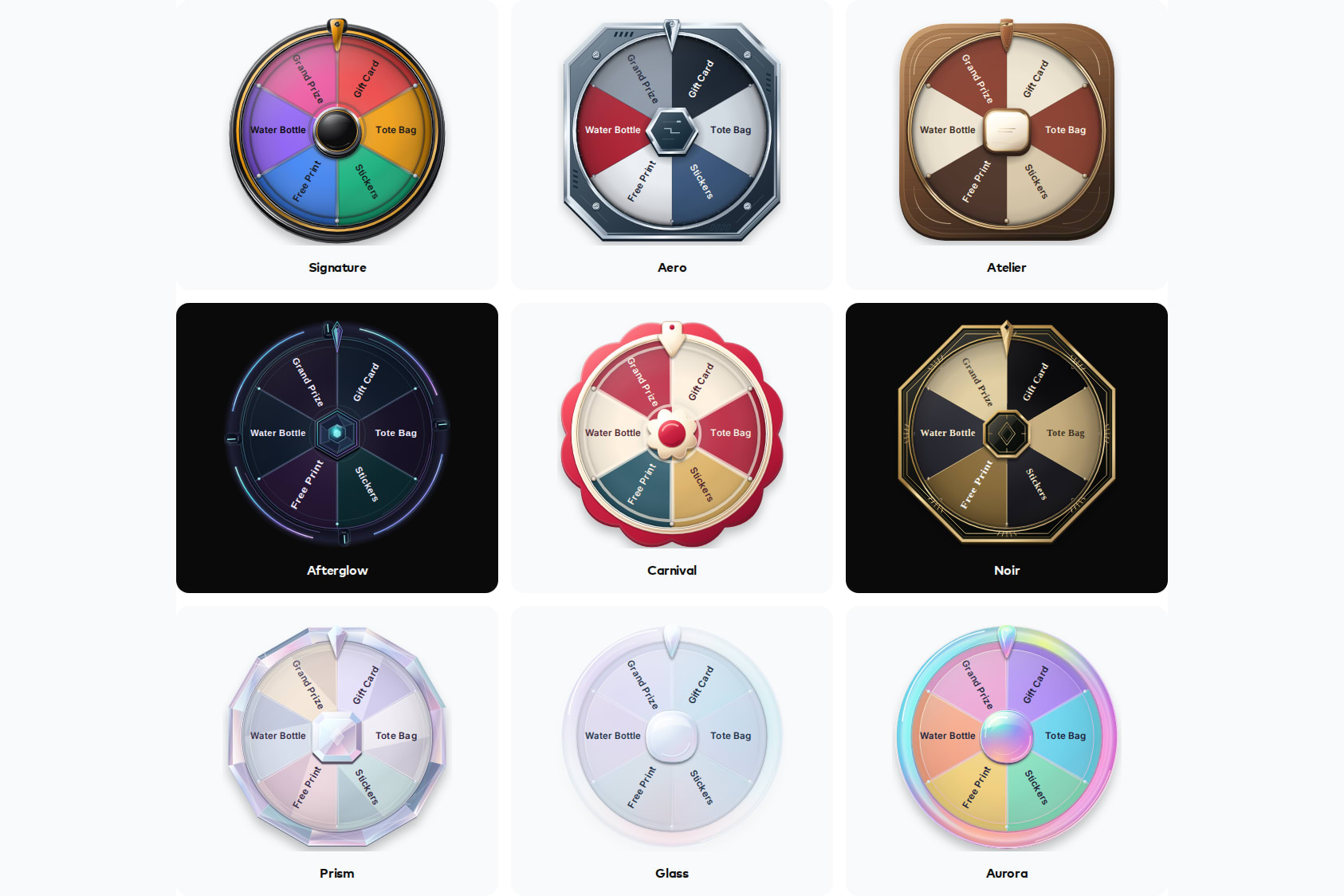
The wheel comes in nine themes: Signature, Aero, Atelier, Afterglow, Carnival, Noir, Prism, Glass and Aurora. And it runs on the hardware you bring: a kiosk, an iPad on a stand or a laptop at the booth, or a big screen on the wall with guests spinning from their own phones.
Why does free swag end up with the wrong visitors?
Because free isn't just a lower price. It's a different kind of offer, and it pulls a different crowd.
In a study published in 2007, Kristina Shampanier, Nina Mazar and Dan Ariely set up a booth in MIT's student center with two boxes of chocolates and a sign that read "one chocolate per person." When a Hershey's Kiss cost 1 cent and a Lindt truffle cost 15 cents, 27% of the people who took a chocolate chose the Kiss. When the Kiss was free and the truffle cost 14 cents, 69% took the Kiss, and the truffle's share fell from 73% to 31%. The gap between the two prices never moved. In the authors' words, people "appear to act as if zero pricing of a good not only decreases its cost, but also adds to its benefits" (Marketing Science, 2007).
Your swag bowl is that booth. A free tote pulls people who like free totes. The fix isn't hiding the swag. It's asking for something first, and the most honest ask a booth can make is a guest's details and their consent to hear from you.

Getting people to the booth at all is a separate job. See how to draw a crowd at your trade show booth.
Why does a chance to win beat a guaranteed gift?
Because uncertainty is exciting, and excitement keeps people going, as long as they're focused on playing.
70% vs 43%
Asked to drink 1.4 liters of water in two minutes, 70% of participants finished when the reward was a dollar or two, decided by a coin toss. Only 43% finished when the reward was a guaranteed two dollars. Source: Shen, Fishbach and Hsee, "The Motivating-Uncertainty Effect," Journal of Consumer Research, 2015.
The uncertain reward was worth less on average, yet more people worked for it. The researchers found the effect held only when people were focused on the process of chasing a reward, not on the reward itself. They also suspect it weakens as rewards get bigger, since a big prize drags attention back to the outcome.
Read that as a brief for your wheel. The spin is the process, so make it worth watching: a wheel turning on a screen, pegs catching the pointer as it settles. And keep the headline prize in proportion.
There's a quieter effect too. Anja Göritz's 2006 review of web survey experiments found that offering an incentive made people more likely to start a survey and, once they'd started, more likely to finish it. Most of the incentives tested were prize draws. A data capture step is a short form, and a chance to win is a good reason to fill it in.
How do you set up a prize wheel for a trade show booth so swag reaches the right visitors?
Start with the prize list, because the prizes decide who stops.
A prize your buyers want pulls buyers. Your own product, a working session with your team, an upgrade only a customer could use. A generic gadget pulls everyone. Put the prizes that matter on the wheel, give each one its own artwork and color so it reads from across the aisle, and let smaller items fill the lower tier.
Then treat quantities and odds as two different decisions. With Spin to Win, you set the odds on every prize in the prize editor. You load the inventory for each one too, and a prize that runs out hides from the wheel automatically. Sam's version of the same point: "Once the one Yeti water bottle has been won, it immediately takes away that pie slice from the spinner wheel. You don't have to scratch it out with a Sharpie marker." Odds that simply followed stock would give away your biggest pile fastest. Yours don't have to: a headline prize can stay rare on day one even if you brought plenty for day three.
Next, make the data capture step do some qualifying. Add a qualifying question in the entry form (a dropdown or a button choice), such as role or buying timeline, and keep it to the one or two your sales team actually routes on. Each email address gets one spin per activation session, so nobody can keep replaying under the same address.
Two mistakes to avoid. The first is a grand prize so big it becomes the only thing anyone thinks about. That's the outcome focus the uncertainty research warns about, and it turns a booth into a lottery queue. The second is odds nobody set, so the good prizes are gone by noon and the afternoon crowd spins for stickers. Both are incentive problems more than technology problems, a pattern we unpack in why event activations fail. One practical step comes before all of it. Check your show's exhibitor rules on games of chance before you plan the wheel.
A well-known model of trade show performance splits a booth's job into three stages: attracting visitors, making contact and converting them (Gopalakrishna and Lilien, Marketing Science, 1995). A wheel is an attraction device. These choices are what carry it through the other two.
Should the wheel run on a tablet or on the big screen?
Both work. Pick by what your booth needs to do.
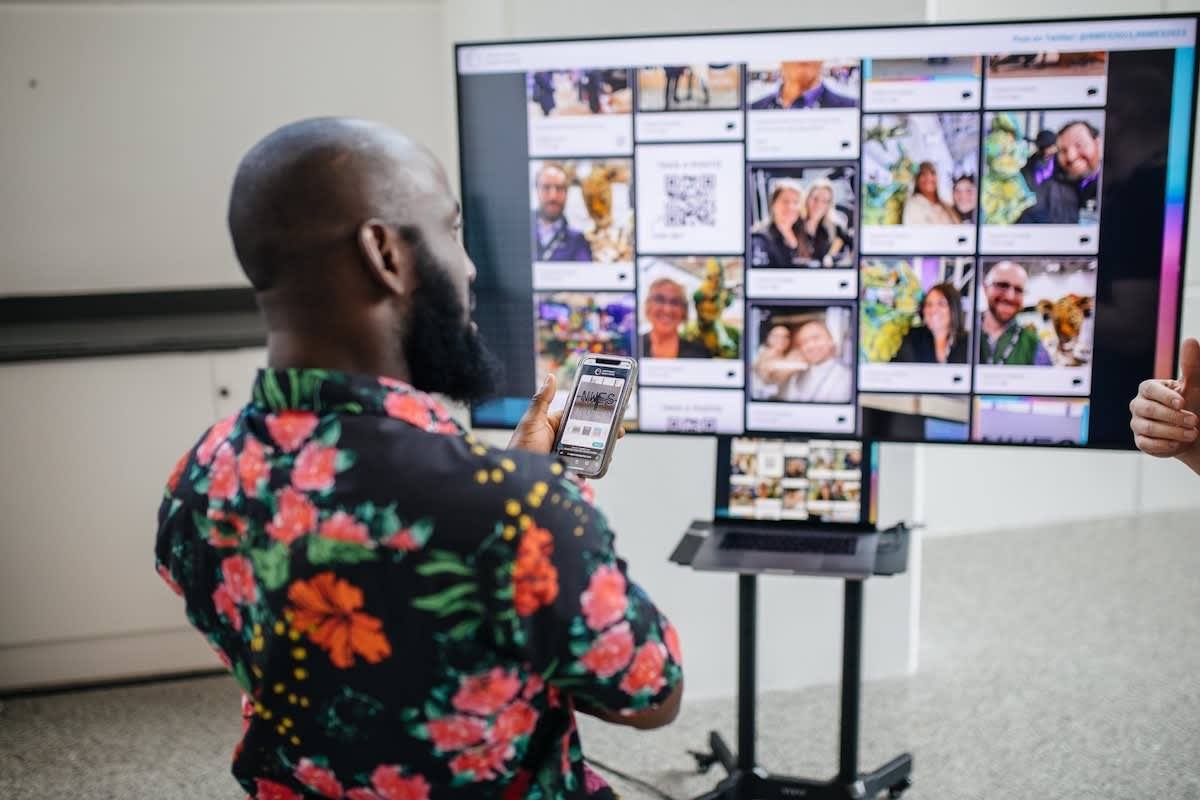
Big Screen and Phone mode puts every spin where the aisle can see it. Guests scan the code on the display and play from their own phones. Their spins queue on the big screen with live position updates, and each prize shows on the wall and the phone together. The claim code never appears on the wall. It goes to the winner's phone and their winner email. It's the mode we'd pick for a booth that needs noticing, because the spin becomes something to stop and watch.
A tablet at the booth, or a QR code on the counter, suits a staffed demo table where you'd rather start a conversation than gather a crowd.
Either way, the moment that counts is the claim. The winner has a claim code in hand. Your staff mark the prize claimed on the Winners tab, and now someone on your team is talking to a visitor who came back on purpose. For other formats that work on an expo floor, see our trade show and exhibitor booth page.
How do you measure a trade show prize wheel?
Count what the platform records, and be clear about what it can't see.
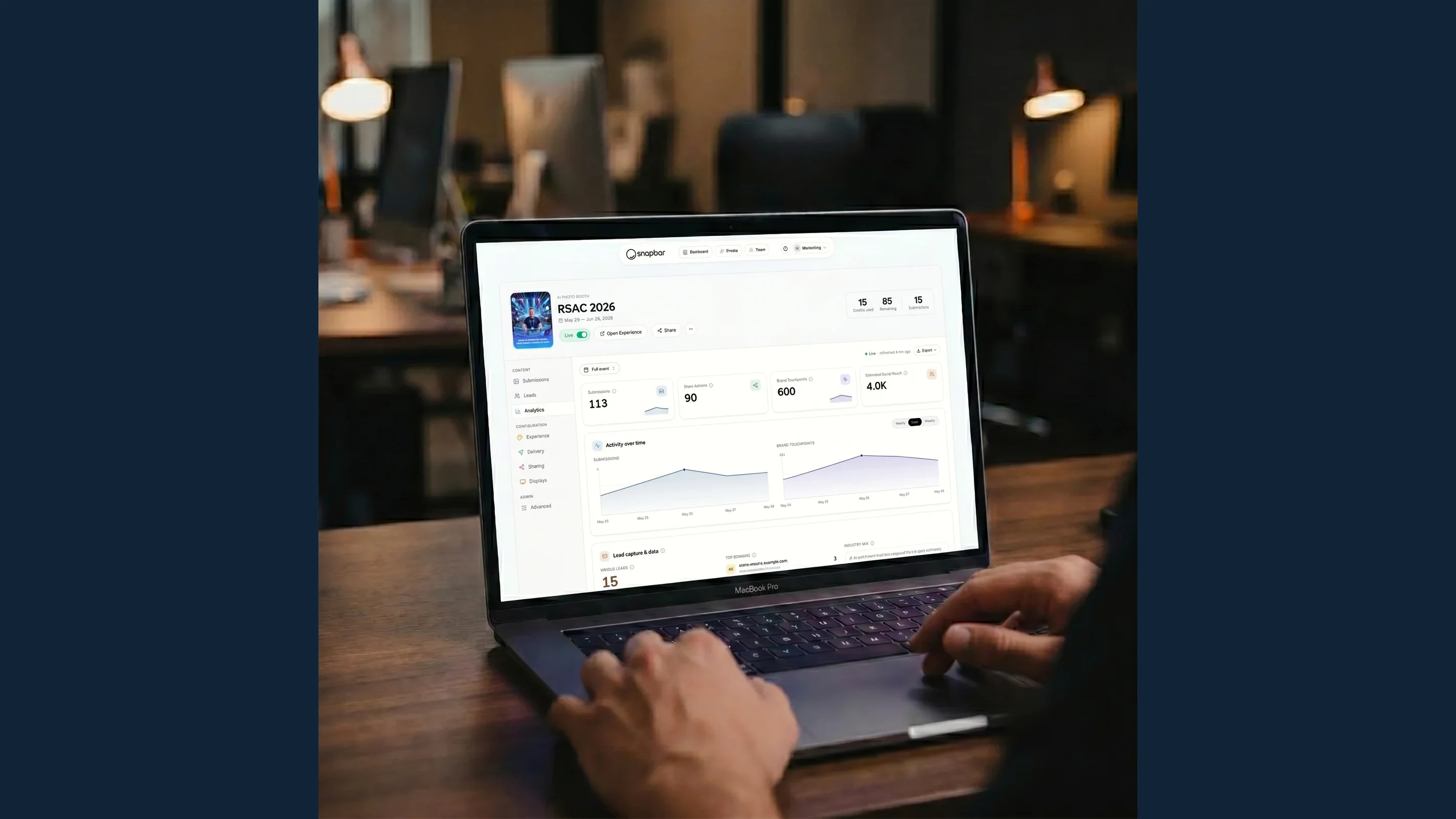
The Spin to Win analytics tab and its lead-capture card cover the left column below. On the Winners tab, your team can also search plays, void a win (the prize goes back into inventory) and export a CSV.
| The platform reports | The platform does not report |
|---|---|
| Players and winners | Whether a player was the visitor you wanted (your qualification and CRM decide that) |
| Prizes claimed, marked by your staff | The conversation that started at the claim |
| Win and claim rates, and plays by day | Meetings booked as a result |
| Prize distribution | Which leads turned into pipeline |
| Leads from the entry step, on the lead-capture card | Aisle traffic that watched but never scanned |
Watch the claim rate first. A winner who walks back to collect is the closest thing a prize wheel has to a count of visitors who returned to talk. It's a proxy, not a meeting booked, so say that in the debrief.
To carry the numbers through to pipeline, see how to measure event activation ROI. For what happens to the lead data afterward, read where your event lead data actually goes.
See it in action
Build your own Spin to Win activation
A branded prize wheel with odds you control, prizes that hide when they run out, and a lead behind every spin.
Explore Spin to WinOne play, run well, puts your giveaway budget in front of the people it was bought for. It isn't the only play on a show floor, though, and the next one looks similar enough to confuse.
Is a prize wheel the same as a booth contest?
No. A contest rewards the best entry. A giveaway decides who gets the swag. If you want guests making something and the crowd voting on it, that's a different play, and we cover it in trade show booth contest ideas.
A prize wheel doesn't create content either. A spin isn't something guests post the way they'd post a portrait of themselves. If you want marketing fuel from the same booth, run a capture activation as its own experience beside the wheel, and let each one do its own job. You can run both: the wheel decides where the swag goes, and the capture gives visitors something worth posting.
Want your swag in the right hands?
Share your show dates and the visitors you want to reach, and we'll help you shape the prizes and odds around them.
Get a QuoteOr explore: Spin to Win | Activation Concepts