
Table of Contents
Ask the internet how far ahead to book an event activation and you'll get answers ranging from two weeks to twelve months. We wanted a real number, so we measured our own. Across thousands of booked activations between January 2021 and August 2026, the median event activation planning timeline is 28 days. Not months. Days. Half of what we run books inside a month of the event date, and close to a quarter of it inside two weeks. That gap between published advice and observed behavior isn't sloppiness on anyone's part. It's two different clocks, and most planning guides measure only one of them.
Key takeaways
- Median lead time is 28 days across booked activations from January 2021 through August 2026. The middle half falls between 14 and 55 days.
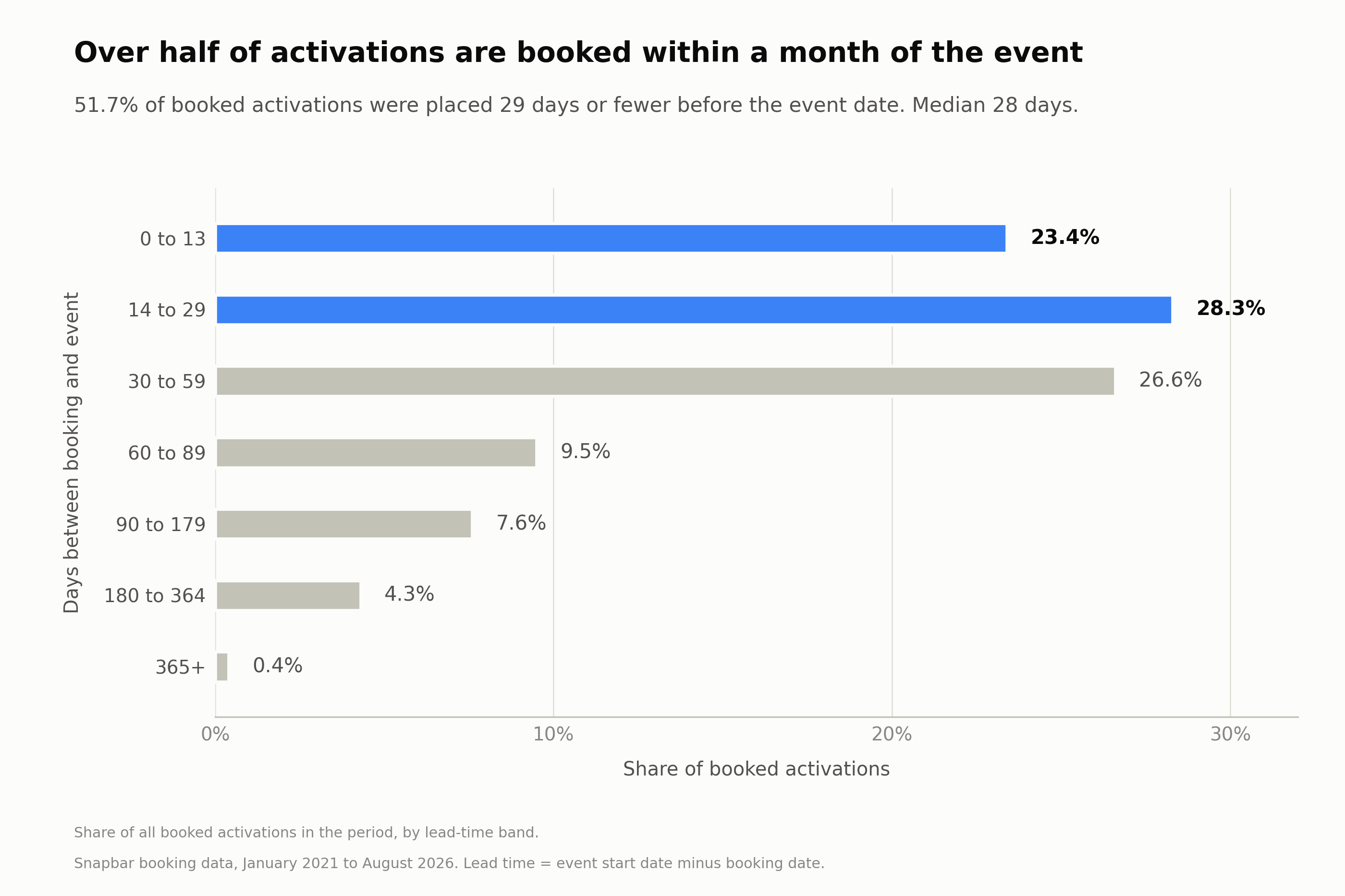
- 51.7% are booked within 29 days of the event date and 78.3% within 59. Only 12.3% book more than 90 days out.
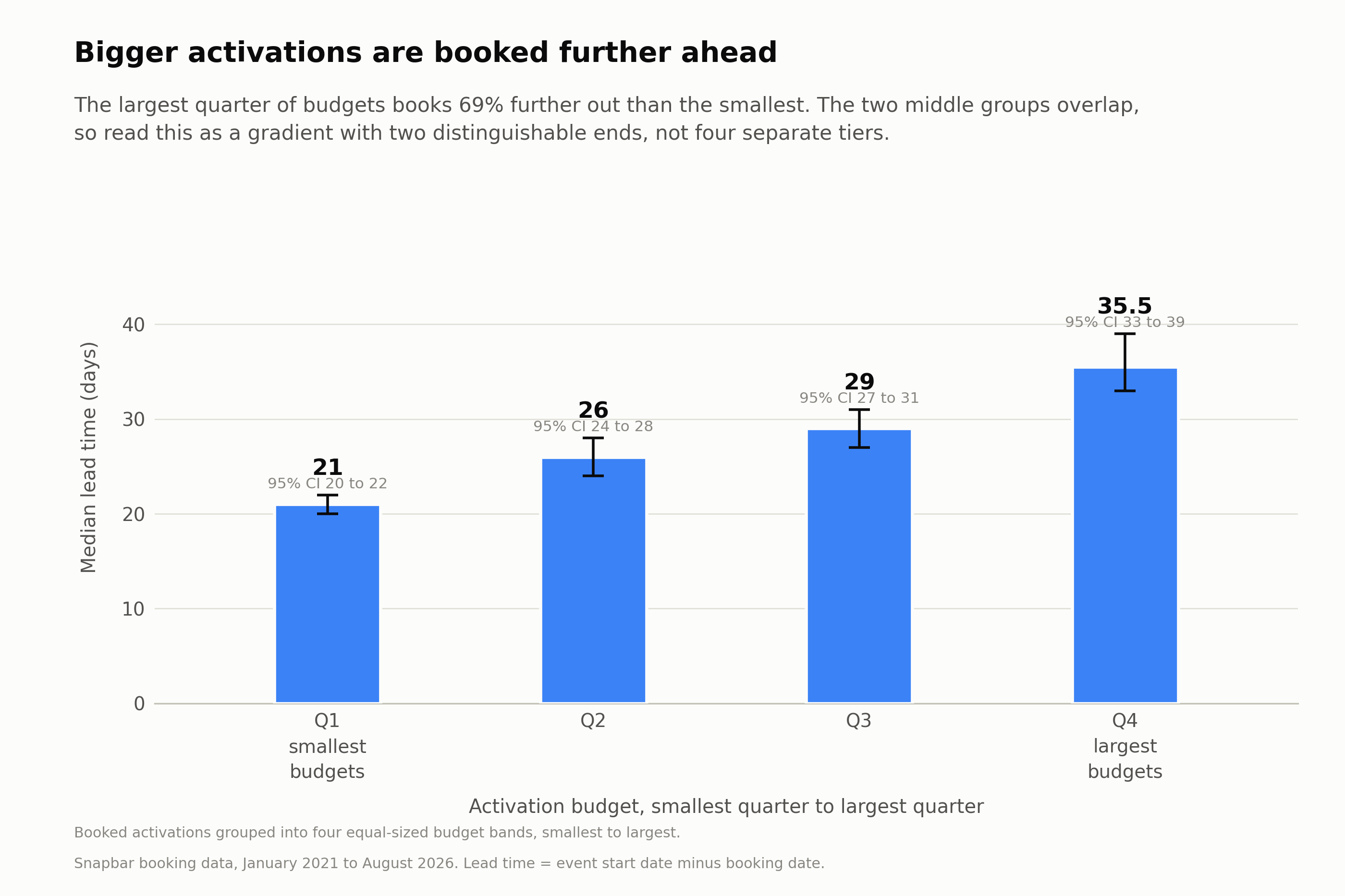
- Budget moves the window more than anything else we measured. Smallest quarter of budgets: 21-day median. Largest: 35.5, roughly 69% longer.
- Something changed between 2022 and 2023. The median stepped from 28 days to 38 and has been flat since.
- October and December need the most runway: 40 and 38 days, against 27 for February and March.
- One caveat travels with all of it. 2021 was a short-notice COVID-recovery year that pulls the pooled median down.
How far in advance do brands actually book event activations?
The median is 28 days, measured across our booked activations between January 2021 and August 2026, where lead time is the event date minus the date the booking was created.
The spread matters more than the midpoint. The 25th percentile sits at 14 days and the 75th at 55, so the middle half of what we book lands between two weeks and roughly eight weeks out. The 90th percentile is 101 days. The mean is 47.1 days, well above the median, which is what a right-skewed distribution looks like: a long tail of programs booked six months ahead pulls the average up while most of the volume sits near a month. Use the median. The average describes a pattern almost nobody has.
Grouped into bands: 23.4% of booked activations fall within 13 days of the event, 51.7% within 29 days, 78.3% within 59. Only 12.3% book more than 90 days out.
That distribution pairs with the wider benchmark set in our roundup of experiential marketing statistics.
Why does published advice put the event activation planning timeline at 6 to 12 months?
Because it's measuring a different decision. Nearly every planning timeline you'll find online tracks the host organization's clock: securing the venue, locking the date, building the program, opening registration. That work really does run months ahead, and the industry research backs it.
Global DMC Partners' Q3 2025 Meetings & Events Survey, fielded with 151 meeting and event professionals worldwide, found meeting and conference lead times with "nearly half falling into the four- to nine-month range," while incentive programs run far longer: 41% planned 10 to 12 months ahead, another 25% starting 13 to 24 months out. Northstar and Cvent's Meetings Industry PULSE survey reports the same shape, with many new events planned 7 to 9 months out.
Those are real numbers for a real decision. They're just not the decision a brand marketer makes when they book an activation. By then the event has usually existed on a calendar for months. The venue is signed. The floor plan is set. The activation is a downstream call on the brand's clock, and that clock runs an order of magnitude shorter.
The industry's flagship forecast steps around this. Amex GBT's 2026 Global Meetings & Events Forecast, built on a YouGov survey of 601 meeting professionals in eight countries fielded July 14 to 21, 2025, tells planners to "book early for their 2026 events." Search it for a lead-time figure and there isn't one. The advice is real; the measurement behind it isn't published.
We haven't been better. Our own guide to corporate event activation strategy answers this question with "4 to 6 weeks of lead time," a number that came from internal impression rather than data. It isn't wildly off, but 28 to 42 days starts at the measured median and climbs from there, and it says nothing about the quarter of activations booked inside two weeks. We're correcting that page.
Does activation size change the booking window?
Yes, and budget is the strongest predictor we found. Split priced activations into four equal-sized budget groups, smallest to largest, and the median climbs at every step, from 21 days in the smallest to 35.5 in the largest.
The ends are cleanly separated: the smallest quarter of budgets books at 21 days and the largest at 35.5, about 69% longer. The two middle groups, at 26 and 29 days, overlap statistically, so we won't claim each rung is its own finding. It's a gradient with two distinguishable ends.
Practically: the bigger the footprint, the more 35 days is a floor rather than a target. Among the largest budgets, roughly one in four activations books 60 days out or more. Those are also the projects where the measurement plan has to exist before the event, and our guide to measuring event activation ROI covers what to instrument while there's still time to instrument it.
Are brands booking earlier than they used to?
Once, and then it stopped. Between 2022 and 2023 the median lead time stepped up from 28 days to 38, and it hasn't moved meaningfully since.
| Booking year (Jan to Aug) | Median lead time |
|---|---|
| 2021 | 27 days |
| 2022 | 28 days |
| 2023 | 38 days |
| 2024 | 38 days |
| 2025 | 36 days |
| 2026 | 39.5 days |
January to August bookings only, every year, so each row compares an equal calendar window. Snapbar booking data. The 2023 through 2026 rows are statistically indistinguishable from one another; the only separation that holds is 2022 versus 2023. 2026 is a partial-year cohort.
Read that as one step, not a trend line. We built it as a table on purpose, because a line chart would invite a year-over-year story the data doesn't support. And 2021 gets its own asterisk: a COVID-recovery year of short-notice bookings that drags the pooled median down. Whatever reset the market between 2022 and 2023 has held for four booking years since, which fits the normalization we tracked in event industry trends for 2025 and 2026.
How much lead time does an October or December event need?
Roughly 10 to 13 days more than a first-quarter one. Looking only at events held between 2022 and 2025, October events were booked at a 40-day median and December at 38, against 27 days for both February and March.
That premium belongs to those two months, not to the back half of the year as a block. November's median is 32 days, close enough to February's range that we won't separate them. Our read is competition for the same weeks more than complexity: October is the busiest event month in the data, and the calendar fills before the creative brief does.
The usable version is a habit, not a rule. Back-date from the event, use 28 days as the baseline, then add about two weeks if it lands in October or December. If you're building a trade show presence in that window, our rundown of interactive trade show booth ideas is worth reading before the brief locks. If the December event is a holiday party, here is what to run.
Does a digital activation need less lead time than an AI activation?
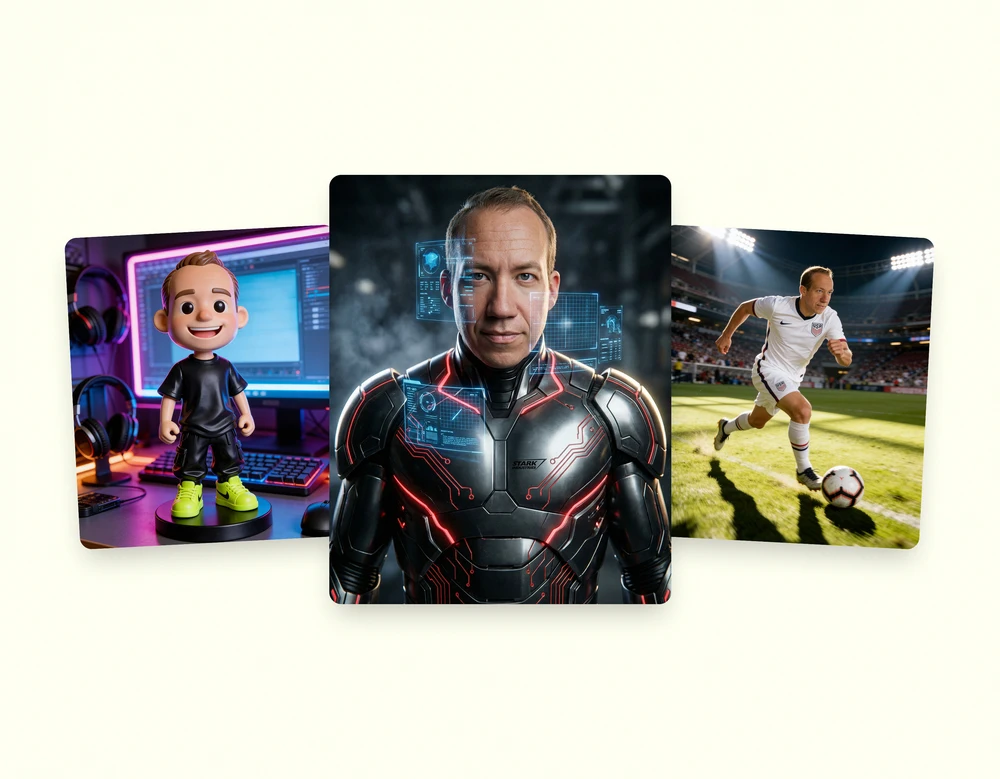
Yes, by about a week. Digital Photo Booth activations were booked at a 27-day median; AI Photo Booth activations at 35.
The reason isn't logistics. Both ship on the same platform and set up in about the same time on site. The difference is creative approval. An AI activation adds prompt development, a review round on generated output, and a sign-off on how guests get rendered, and that loop is what adds the days. It's worth them. Nobody wants to discover on event morning that the model is doing something unflattering with the CEO's glasses.
Those two are the clearest contrast in the data. We're not publishing a per-product table, because the remaining differences sit inside the margin of error and we won't present noise as a finding. If you're weighing formats against the runway you have, the experiential marketing platform overview lays out what each family involves.
What is the shortest realistic lead time for an event activation?
Shorter than most guides admit. 23.4% of booked activations were placed within 13 days of the event, and the 10th percentile sits at 7 days. Short notice isn't an edge case here; it's close to a quarter of the business.
Platform access is not the constraint. You can be inside the platform quickly, exploring activation types, inviting your team and managing access, and customizing branding and styling for your microsites. From there our team handles deployment, custom AI styles included, in a matter of days. Digital Photo Booth sits further ahead again: it is close to self-service end to end, once billing and contract are settled.
What decides whether a compressed timeline holds is usually on your side. Design forms, brand assets, logo files, microsite approval: those sit with the client. Configuration and build compress well. Waiting on a logo file from an agency that is out of office does not.
If you run activations regularly, the fix is structural rather than heroic. Keeping brand assets, approved copy, and a default data capture step in a ready state turns a two-week booking from a scramble into a normal week. That's most of the argument in our in-house brand activation playbook.
How we measured this
Lead time is the event start date minus the booking creation date, in days, per activation in Snapbar's CRM. The population is closed bookings, Scale Headshots excluded, over a window running January 2021 through August 2026. Confidence intervals are bootstrap intervals on the median.
Records created before 2021 are excluded, and not because they're old. Every pre-2021 record carries a single bulk-import creation date from a CRM migration, so lead time there is undefined by construction. Also excluded: bookings with no event date, and a small number of records carrying impossible or implausible dates.
Three limitations. 2021 was a short-notice recovery year and pulls the pooled median down. 2026 is a January to August booking cohort, not a full year. And this is our book of business rather than the market: it reflects the formats we sell and the buyers who find us, which is exactly why these numbers run shorter than a venue-sourcing survey's.
Working backward from an event date?
Send us the date and format. We'll tell you what's buildable in the window you have.
Get a QuoteOr explore: Experiential Marketing Platform | How It Works